
Philosophy
Throughout my life, I’ve often enjoyed trying to help others learn. My first real stint in doing this was in high school as a paid tutor to help my friends with their Algebra, Geometry, and SAT preparation. But, the idea of becoming a teacher began when I met my 11th grade English teacher, Mr. Levine. Throughout his lessons, I came to appreciate the nuances of literature and language. And, from that moment onward, I knew I wanted to be a teacher just like him: knowledgeable, compassionate, and with a bit of humor sprinkled in! Over the next ten years, I became a high school English teacher and taught various subjects with many different kinds of students.
In my own classroom, I often opted for a social constructivist view of learning, which uses mutual knowledge and cooperative learning so students can share, question, and critique class content. In many classrooms I have seen, students often fear giving the “wrong answer,” so they end up not participating. But, when students can share their beliefs without that fear—i.e., it’s okay to be “wrong”—they end up making meaning together in ways that I did not original intend. Although there are many times a teacher needs to be the “sage on the stage,” I often see myself more as a “guide on the side” so students have the freedom to discover their own meaning from my lessons.
Lastly, in terms of technology’s role in the classroom, I believe it can play a very important role in student success. Although technology will likely never fully replace the instructor, it can be an effective way to aid the teacher in the organization and delivery of content, and for motivating students. For example, teachers may opt to “gamify” their instruction by adopting online behavior management software, such as Classcraft or ClassDOJO. Or, teachers may opt for making their presentations more interactive by including add-ons such as Pear Deck. Likewise, technology can be used to augment students with the tools to make their learning more impactful. For example, students can use one of the wide array of online tools for content creation and knowledge sharing, such as Socrative or Padlet, or opt for using interactive mind-mapping software, such as Coggle, to help link their thoughts together.
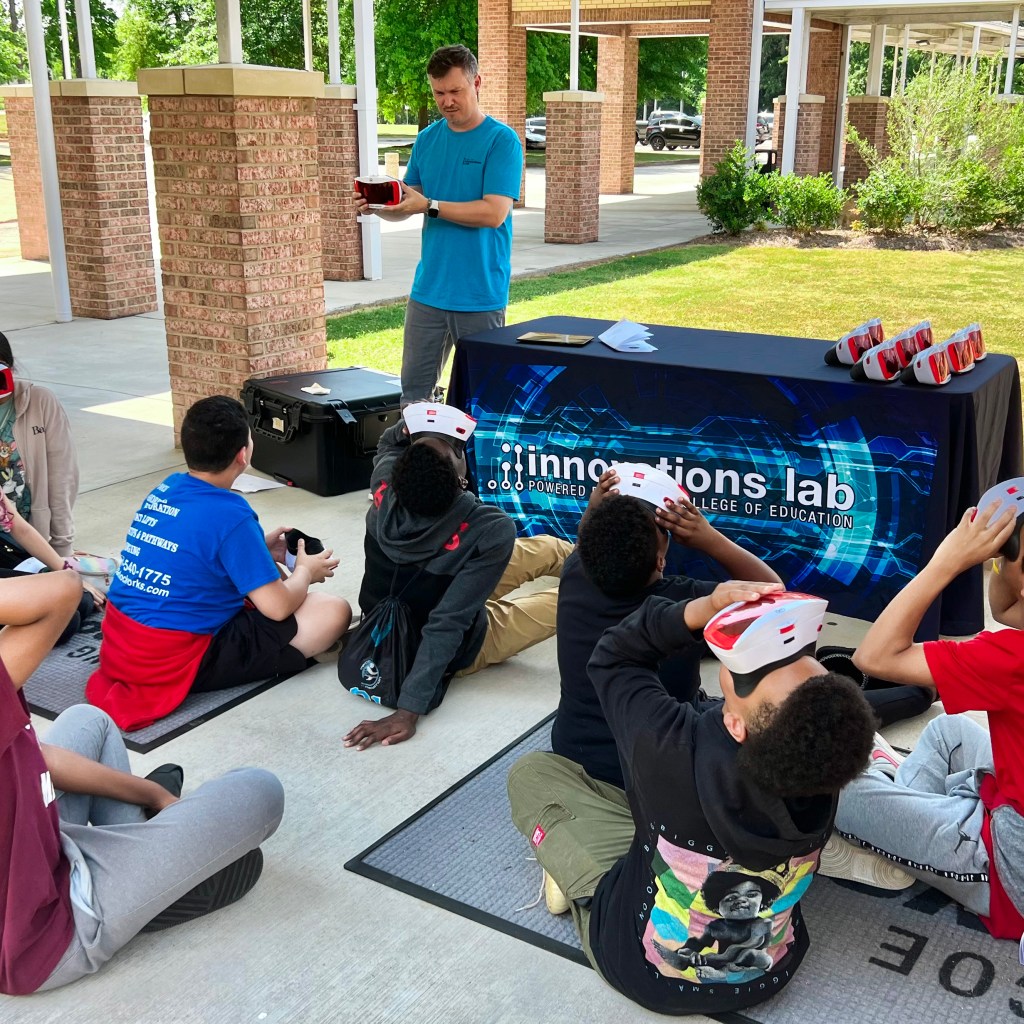
In all, technology can be a great addition to any learning environment. However, technology should not be carelessly used just because it is available; at times, using no technology can be just as effective. Most importantly, when using technology in my classroom, I encourage teachers to infuse it so that students can be active participants in learning with the technology, rather than passively seeing the technology used by the instructor (Niederhauser, 2013).
Courses Taught
I have taught many courses in the application of educational technology, including:
- Issues in Instructional Technology (MEDT 8463), which focuses on examining advanced topics in the theory, selection, production, and utilization of technology-based instructional materials.
- Designing Technology Enhanced Instruction (MEDT 7464), which focuses on the application of instructional design principles as they relate to instruction.
- Introduction to Educational Technology (EME 2040), which focuses on the application of instructional design principles to enhance the quality of teaching and learning in the classroom.
- Technology Enhanced Learning Environments (EME 3813), which focuses on the foundational principles of human learning with technology, the design of technology-enhanced learning environments, and how technology can be used to support instructional activities.
- Technology in Secondary Education (EME 4406), which focuses on giving students hands-on experiences in integrating technologies into diverse learning environments that span a variety of secondary academic disciplines.
- Teaching Digital Storytelling (LAE 6869), which focuses on learning how digital storytelling—the practice of using computer-based tools to tell stories—can be integrated into K-12 classrooms, higher education settings, and a variety of other professional spaces.
Student Evaluations
As an instructor, I have received several excellent teaching evaluations:
- “[He] is a great teacher who teaches about technological aspects of education in a very non–condescending way, which I found very rare and valuable. Unfortunately, I have found that many male professors teaching more basic topics (like software, hardware, etc.) to a group of mostly female students can come across as demeaning; however, he answered questions in a manner that was very uplifting and genuinely positive.”
- “[He] places great emphasis on the use of knowledge, the cultivation of skills, and the development of creative thinking instead of memory. He has brought us many brand–new educational technology concepts. His speech and PowerPoint are very interesting.”
- “[He] is incredibly upbeat and welcoming in his classroom– a three hour block class is always a little bit intimidating, but I liked to attend his class every week because of his style of teaching and ability to keep us engaged through different means of absorbing information. I felt like I was seen by him and every assignment we did was actually fun for me to complete.”
- “[He] is arguably the most enthusiastic instructor I have had at UF. He is a great teacher when it comes to making the course content clear and understood but beyond that he went above and beyond to make class feel normal in the times of [COVID]. I don’t have enough good things to say about him, he is absolutely one of the best instructors UF has seen.”
- “He was so fun and engaging. He gave us the best feedback and by best I mean: feedback that was both constructive and real. In all his comments in our discussions and assignments, he conveyed a true sense of authenticity and regard for our work. He showed interest in our interests and He was friendly enough to give us updates about his personal life and adventures throughout the semester which really made me feel like a member part of a community within his own course.”
- “[He] is one of the best professors I have ever had. His way of facilitating discussions and setting the class up to where we are interested and also creates an interactive environment without being forceful of participation which is perfect. He is so patient, so kind, and really cares about stretching our minds with critical thinking while having fun doing it.”
 John Hampton, Ph.D.